
Summary
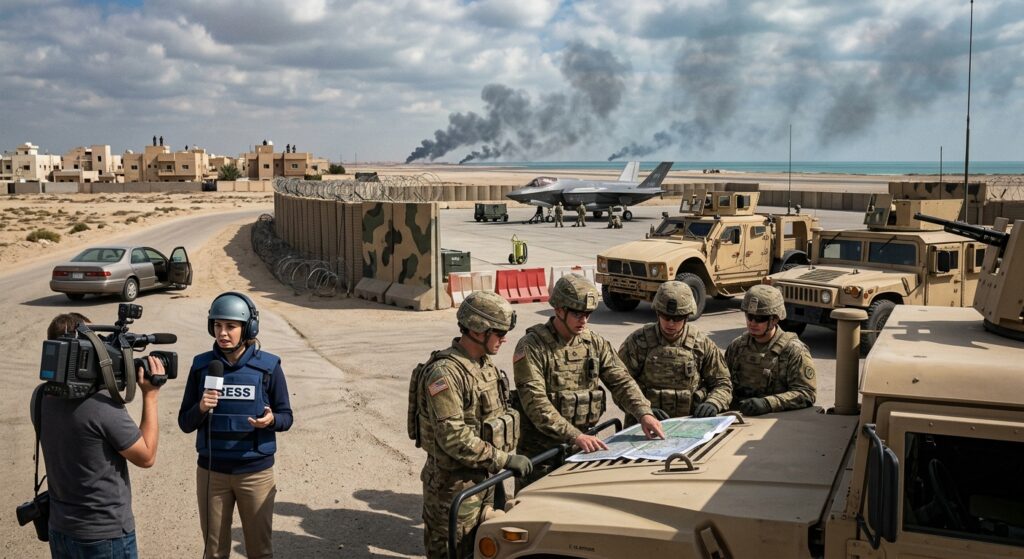
The 2026 escalation between the United States and Iran led to Iranian missile and drone strikes on U.S. military installations in Kuwait and Bahrain, following U.S. retaliatory airstrikes on Iranian facilities. These hostilities deepened concerns over regional security and the safety of military infrastructure in Gulf states. The attacks, executed by Iran’s Islamic Revolutionary Guard Corps (IRGC), resulted in civilian casualties, property damage, and a dramatic drop in maritime traffic through the critical Strait of Hormuz. While most projectiles were intercepted, the episode underscored Iran’s military capabilities and intentions to challenge U.S. influence in the region.
Incident Overview
In early March 2026, heightened tensions resulted in Iranian missile and drone attacks on U.S. bases in Kuwait and Bahrain. This followed U.S. strikes on Iranian military sites, initiated in response to earlier assaults on commercial shipping. The IRGC employed various advanced weapons, targeting locations like Bahrain’s Fifth Naval District and Kuwait’s Ali Al Salem Air Base. Despite successful interceptions, debris from intercepted missiles caused civilian injuries and damage, demonstrating the perilous nature of the conflict and its ramifications for local populations.
Targeted Locations and Military Capabilities
Iran targeted key installations in Kuwait and Bahrain, specifically areas like the Bandar Salman in Bahrain and Ali Al Salem Air Base in Kuwait. The attacks included coordinated strikes using ballistic missiles and drones, highlighting the IRGC’s sophisticated military capabilities. The missile assaults disrupted normal life and damaged infrastructure, raising alarm about the vulnerability of these Gulf states amidst the escalating U.S.-Iran confrontation. Defense forces in both countries responded effectively, but the fear of further escalation remained high.
Reactions and Impact
The Iranian attacks were met with immediate condemnation from Kuwait, Bahrain, and Saudi Arabia, emphasizing violations of sovereignty and international law. Each state mobilized military responses while also recognizing the need for cooperative regional security measures against Iranian aggression. The conflict exacerbated fears for civilian safety and emboldened calls for enhanced defense mechanisms among Gulf states. Economically, the conflict disrupted trade and shipping routes, particularly through the Strait of Hormuz, impacting global markets and leading to increased tensions among regional actors.
Broader Geopolitical Consequences
This surge in hostilities marked a significant shift in the security perceptions of Gulf states toward Iran, driving them to seek stronger collective defense strategies. Efforts led by Pakistan and Qatar aimed at de-escalation showed some promise, yet the underlying divergence between U.S. and Iranian policies complicated resolution efforts. The ongoing conflict not only threatened the fragile balance of power in the region but also reshaped alliances, encouraging Gulf states like Kuwait to reconsider their diplomatic ties and security strategies regarding both Iran and the United States.
The content is provided by Reagan Chase, ZenModeLife