
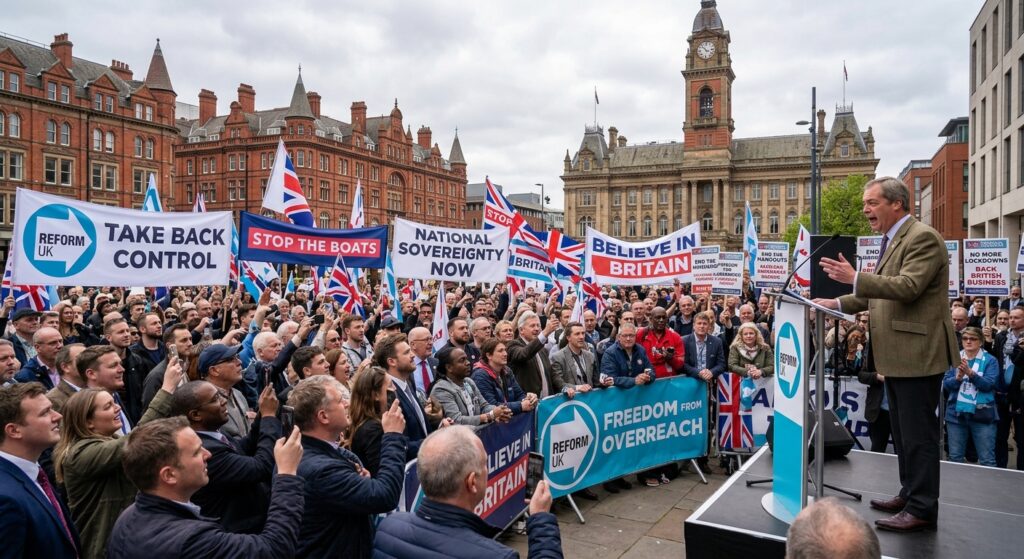
Summary
Reform UK, evolving from the Brexit Party, emerged as a distinct political force advocating for national sovereignty and immigration control. Established in 2018 by Nigel Farage, the party rebranded in 2021 to broaden its agenda, gaining traction by emphasizing opposition to government overreach during the COVID-19 pandemic. It positions itself as an alternative to the Conservative and Labour parties and achieved notable successes in the 2024 general election, winning parliamentary seats and council positions, which have bolstered its influence among disenchanted Conservative voters and other demographics.
Background and Political Strategy
Founded as the Brexit Party, Reform UK quickly grew as a force for hard Brexit, subsequently rebranding to address wider domestic issues. This transformation allowed Reform UK to challenge both Conservative and Labour policies, particularly on immigration and economic growth. The party’s electoral strategy focuses on establishing a strong presence in local government as a foundation for greater electoral challenges, successfully winning over 300 council seats in key areas.
Electoral Performance
The party’s electoral success peaked in 2024, where it won five parliamentary seats and a considerable number of council seats during the 2025 local elections. These victories highlighted its ability to attract former Conservative voters, particularly in traditionally Labour-dominated areas, showcasing Reform UK’s effectiveness in reshaping political dynamics. However, there are concerns about whether this growth can be sustained amid emerging challenges and criticisms.
Voter Base Characteristics
Reform UK’s voter base has shifted, with significant support coming from former Conservatives, indicating a substantial realignment within the right-wing electorate. While maintaining core characteristics of the previous UKIP base, its supporters are generally more educated and economically secure. This change reflects a broader appeal that includes a mix of working-class and middle-class voters, thereby complicating traditional political categorizations.
Leadership Dynamics
Under Nigel Farage’s resumed leadership, following the party’s rebranding, Reform UK has aimed to establish a credible political presence. This focus involves addressing governance issues at local levels and engaging strategically with other political entities, potentially increasing its parliamentary influence. The party’s commitment to maintaining a distinct identity while managing practical governance challenges remains under scrutiny.
Public Perception and Media Attention
Reform UK has garnered significant media and public interest, particularly due to its provocative stances on climate change and societal issues. Its challenges to mainstream institutions reflect a dual strategy of critique and accountability, drawing both support and criticism. As it secures a growing voter base, the party must navigate external perceptions and internal policy coherence to maintain its momentum.
Policy Focus and Challenges
The party’s platform includes hardline immigration policies and a critical view of government climate initiatives, raising concerns about the implications for the green economy. Critics argue that Reform UK’s approach could jeopardize future job creation and exacerbate existing challenges related to environmental targets. Addressing such criticisms while maintaining electoral appeal will be crucial for the party’s sustainability.
Future Prospects
Looking ahead, Reform UK aims to consolidate its gains in upcoming elections by positioning itself as a pragmatic alternative focused on domestic reform. However, questions regarding its policy implications, especially on environmental matters, may affect its ability to govern effectively. As it seeks to expand its influence within the UK political landscape, the party must clarify its commitments and navigate challenges that arise in local governance and national scrutiny.
The content is provided by Emerson Grey, ZenModeLife